Viking tattoos have become one of the most popular choices for people who love Norse mythology, ancient history, warrior symbolism, and bold body art. Designs inspired by Vikings often feature Norse gods, ravens, wolves, axes, ships, runes, dragons, knotwork, and legendary symbols.
The answer is not completely certain. The strongest written evidence comes from the 10th-century Arab traveler Ahmad ibn Fadlan, who described Rus men with dark markings covering their bodies. However, there is no surviving Viking-Age skin that allows historians to confirm exactly how widespread tattooing was among Scandinavian Vikings.
This makes Viking-inspired tattoos especially fascinating. Some designs are based on authentic Norse art, while others come from later traditions or modern interpretations. Understanding the difference can help you choose a tattoo that is both meaningful and visually powerful.
What Are Viking Tattoos?
Viking tattoos are modern tattoo designs inspired by Viking culture, Norse mythology, Scandinavian art, and symbols associated with the Viking Age.
Popular designs include:
- Viking warriors
- Norse gods
- Thor’s hammer
- Odin and his ravens
- Wolves
- Ravens
- Viking ships
- Axes
- Shields
- Norse dragons
- Runes
- Nordic knotwork
- Yggdrasil
- Valknut
- Norse-inspired geometric patterns
Many people choose these tattoos because they represent qualities such as courage, strength, loyalty, protection, adventure, independence, and resilience.
However, not every symbol commonly marketed as a “Viking symbol” actually comes from the Viking Age. Some popular Nordic-looking symbols appeared centuries later.
Did Vikings Really Have Tattoos?
This is one of the biggest questions surrounding Viking tattoos.
There is no direct archaeological evidence from Scandinavia proving that Viking-Age people commonly had tattoos. Viking graves have produced many objects, including weapons, jewelry, tools, and decorative items, but tattooed skin has not survived in a way that provides clear confirmation.
The most famous evidence comes from Ahmad ibn Fadlan, who encountered Rus traders around the Volga region in the early 10th century. His account describes dark markings extending from the toes toward the neck. Different translations and interpretations of his description have led historians to debate whether these markings were definitely tattoos and exactly what they looked like.
It is therefore safer to say that tattooing may have existed among some Viking-connected groups, but we cannot confidently claim that all Vikings were tattooed.
What Did Viking Tattoos Look Like?
Unfortunately, historians do not know the exact designs of the markings described by Ibn Fadlan.
Some interpretations connect the description to dark green or blue-black patterns. Other translations have been understood as references to trees or decorative designs. Because there is no surviving Viking tattooed skin, modern artists cannot recreate an authenticated Viking tattoo pattern.
Modern Viking tattoos therefore tend to borrow their visual language from Viking Age art, rather than from confirmed tattoo examples.
This includes:
- Interwoven animals
- Serpents
- Dragons
- Knotwork
- Runes
- Abstract geometric patterns
- Stylized plants
- Mythological figures
These motifs have historical roots in Scandinavian art found on objects, wood, metal, and stone.
Viking Tattoo Meanings
A Viking-inspired tattoo can have many different meanings depending on the design.
| Viking Tattoo Design | Common Meaning |
| Viking warrior | Strength, courage, bravery |
| Thor’s hammer | Protection and power |
| Odin | Wisdom, sacrifice, knowledge |
| Raven | Intelligence, mystery, guidance |
| Wolf | Loyalty, independence, strength |
| Viking ship | Adventure, exploration, journey |
| Axe | Warrior spirit and courage |
| Dragon | Power, protection, transformation |
| Yggdrasil | Life, connection, balance |
| Runes | Language, symbolism, personal meaning |
| Valknut | Often associated with Odin and the slain |
| Norse knotwork | Continuity, connection, artistic heritage |
These meanings should be treated as modern interpretations rather than assuming every symbol had one universally accepted meaning in Viking society.
Popular Viking Tattoo Designs
1. Viking Warrior Tattoos
Viking warrior tattoos are among the most recognizable Nordic-inspired designs. They can show a warrior wearing traditional-style clothing, holding an axe or sword, or standing beside a Viking shield.
A realistic warrior tattoo can symbolize bravery, determination, resilience, and the willingness to face challenges.
For a dramatic appearance, artists often combine a warrior portrait with a beard, helmet, shield, axe, or background inspired by Nordic landscapes.
2. Viking Ship Tattoos
Viking ships represent travel, exploration, discovery, and adventure.
A longship tattoo can be particularly meaningful for someone who sees life as a journey. The design can include waves, mountains, clouds, ravens, or a dramatic sunset.
Small Viking ship tattoos can work well on the forearm, calf, or upper arm, while detailed ships can become impressive back or thigh pieces.
3. Thor’s Hammer Tattoos
Thor’s hammer, known as Mjölnir, is one of the most recognizable symbols associated with Norse mythology.
A Mjölnir tattoo is often chosen to represent strength, protection, courage, or a connection with Norse mythology.
The design can be simple and minimal or decorated with knotwork and other Nordic patterns.
4. Odin Tattoos
Odin is one of the central figures of Norse mythology and is strongly associated with wisdom, knowledge, war, poetry, and magic.
An Odin tattoo may include his distinctive appearance, ravens, wolves, a spear, or other mythological elements.
Because a detailed Odin portrait requires considerable space, the upper arm, shoulder, chest, back, and thigh are popular placements.
5. Raven Tattoos
Ravens are strongly associated with Odin through Huginn and Muninn in Norse mythology.
A raven tattoo can represent wisdom, thought, memory, observation, or mystery.
For a subtle design, choose a single black raven. For a larger tattoo, two ravens can be combined with runes, mountains, trees, or a Viking warrior.
6. Viking Wolf Tattoos
Wolves have a powerful place in Norse mythology. Fenrir, the giant wolf, is one of the best-known figures.
A wolf tattoo can represent independence, instinct, strength, freedom, and loyalty.
A realistic wolf head can make a striking tattoo, while a more historical-looking design can use Scandinavian ornamentation and knotwork.
7. Norse Rune Tattoos
Runes are another popular choice for Viking-inspired tattoos.
However, choosing a rune tattoo requires care. Different runic alphabets existed at different times, including Elder Futhark and Younger Futhark. A symbol should not automatically be labeled “Viking” simply because it looks ancient.
Before getting a rune permanently tattooed, verify its historical meaning, spelling, and intended context.
8. Yggdrasil Tattoos
Yggdrasil is the great cosmic tree in Norse mythology.
It is often interpreted through modern tattoo culture as a symbol of life, connection, growth, and the relationship between different realms.
Yggdrasil works particularly well as a detailed blackwork tattoo. Roots, branches, animals, and surrounding Norse elements can make the design highly elaborate.
9. Viking Dragon Tattoos
Dragons and serpentine creatures appear throughout Scandinavian art and mythology.
A Viking-inspired dragon tattoo can combine a powerful creature with traditional Nordic knotwork.
This design is ideal for people who want something dramatic, mysterious, and visually complex.
10. Norse Knotwork Tattoos
Norse and Scandinavian art contains intricate animal and interlacing patterns. Styles associated with Viking Age art include Borre, Jelling, and Urnes.
These historical art styles provide a stronger foundation for a historically inspired tattoo than many modern symbols that are incorrectly described as Viking.
Viking Tattoo Symbols and Their Modern Meanings
Viking tattoos are not limited to portraits of warriors. Small symbols can create meaningful tattoos without requiring a large amount of space.
Some popular choices include:
Mjölnir
Often associated with Thor, strength, protection, and power.
Ravens
Associated with Odin and commonly interpreted in modern tattoo culture as wisdom, thought, and knowledge.
Wolves
Often connected with strength, freedom, instinct, and Norse mythology.
Viking Ships
Represent journeys, exploration, independence, and adventure.
Runes
Can represent words, names, concepts, or personal messages when accurately researched.
Yggdrasil
Represents the cosmic tree from Norse mythology and is often used to symbolize life and interconnectedness.
Valknut
A distinctive symbol associated with Norse archaeological contexts and commonly connected with Odin in modern interpretations. Its exact historical meaning remains debated.
Historically Accurate Viking Tattoos vs. Modern Designs

If historical accuracy matters to you, it is important to separate Viking Age evidence from modern Nordic-inspired imagery.
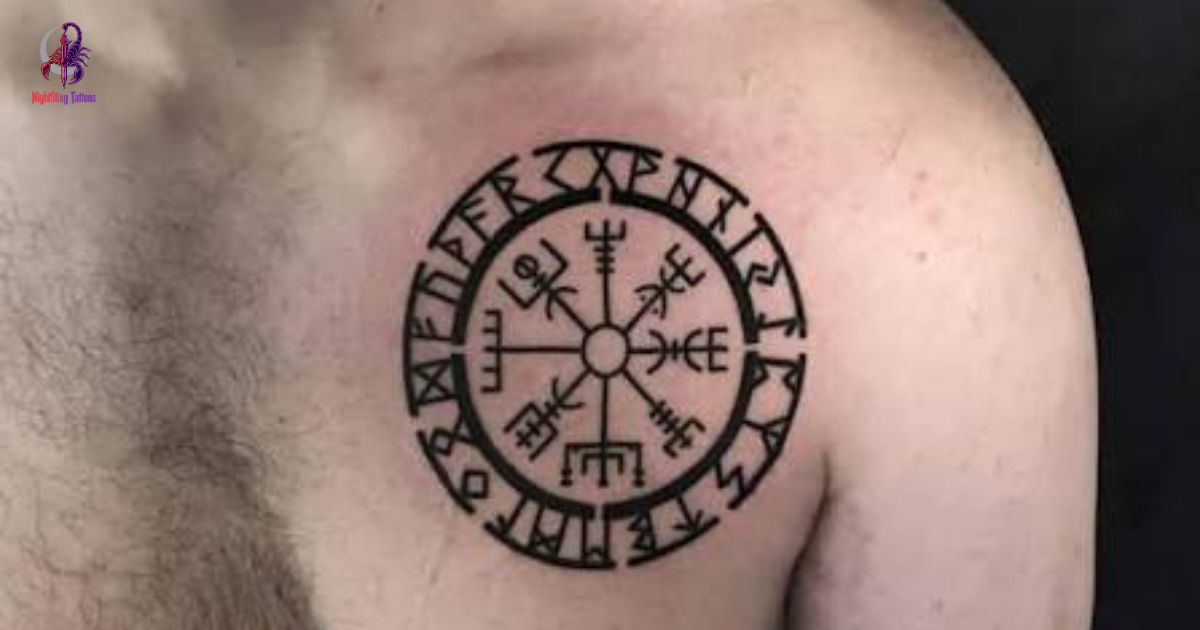
For example, some modern tattoos use Vegvísir, often called the Viking compass. Despite its popularity, it is not a Viking Age symbol. It appears in much later Icelandic magical manuscripts. Similarly, the Ægishjálmur or Helm of Awe belongs to later Icelandic magical traditions rather than the Viking Age.
This does not make these designs bad tattoo choices. It simply means they should be described as later Icelandic or Nordic-inspired symbols, rather than authentic Viking Age symbols.
For a more historically grounded tattoo, consider:
- Viking Age animal art
- Borre-style patterns
- Jelling-style motifs
- Urnes-style designs
- Historically attested runic alphabets
- Archaeologically documented objects and ornament
Best Places for Viking Tattoos
The best placement depends on the size and detail of your chosen design.
Forearm
The forearm is ideal for Viking axes, runes, ravens, wolves, and smaller warrior designs.
Upper Arm
A large Viking warrior, Odin, Thor, or dragon can fit comfortably on the upper arm.
Shoulder
The rounded shape of the shoulder works well with circular Nordic designs and animal artwork.
Chest
The chest provides space for large symmetrical designs, including Viking warriors, ravens, shields, or mythology scenes.
Back
For a large Viking tattoo, the back provides one of the biggest canvases. A full Nordic mythology scene can incorporate several elements.
Leg
The thigh and calf can accommodate detailed Viking ships, wolves, warriors, or long vertical rune designs.
Relevant Post……………Pete Hegseth Tattoos: Meanings, Symbols, Controversies & What They Represent
Best Viking Tattoo Styles
Different tattoo styles can dramatically change the appearance of the same Viking symbol.
Blackwork
Blackwork uses strong areas of black and bold shapes. It works especially well with Nordic knotwork and geometric designs.
Realism
Realistic Viking portraits, wolves, ravens, and ships can create an intense visual effect.
Fine Line
Fine-line Viking tattoos are suitable for people who prefer a more subtle appearance.
Geometric
Geometric designs can combine Nordic-inspired symbols with symmetrical shapes and patterns.
Traditional
Bold outlines and simplified forms can create a classic tattoo appearance while keeping the Viking theme recognizable.
How to Choose the Right Viking Tattoo
Before getting a Viking tattoo, think about what the design means to you.
Ask yourself:
- Do I want a historical design or a modern interpretation?
- Which part of Norse mythology interests me most?
- Do I want a small symbol or a large artwork?
- Should the tattoo be realistic or stylized?
- Does the symbol have a verified historical meaning?
- Will the design still be meaningful to me years from now?
It is also important to research the symbol carefully. Some internet tattoo lists incorrectly describe modern symbols as ancient Viking symbols.
Viking Tattoos for Men
Popular Viking tattoo ideas for men include:
- Viking warrior sleeves
- Thor’s hammer
- Viking axe
- Odin portrait
- Raven tattoos
- Wolf tattoos
- Viking ship tattoos
- Norse dragon tattoos
- Rune tattoos
- Nordic knotwork
Large blackwork or realistic designs are particularly popular for sleeves, shoulders, chests, and backs.
Viking Tattoos for Women
Viking-inspired tattoos are not limited to masculine warrior imagery.
Women may choose:
- Small Viking symbols
- Nordic flowers and knotwork
- Ravens
- Wolves
- Runes
- Viking ships
- Yggdrasil
- Norse mythology characters
- Minimalist Mjölnir designs
- Fine-line Nordic patterns
A Viking tattoo can represent personal strength, independence, courage, family, heritage, or resilience regardless of gender.
Small Viking Tattoo Ideas
If you prefer something subtle, consider:
- Tiny Mjölnir
- Single raven
- Small Viking axe
- Minimalist ship
- One meaningful rune
- Small wolf
- Nordic knot
- Simple Yggdrasil
- Minimal dragon
- Small shield
Small tattoos can be placed on the wrist, forearm, ankle, shoulder, behind the ear, or upper arm.
Viking Sleeve Tattoo Ideas
A Viking sleeve can combine several related elements into one large composition.
For example, a sleeve could include:
Odin + Ravens + Runes + Knotwork
or
Viking Warrior + Axe + Ship + Nordic Landscape
Another option is a mythology-focused sleeve featuring Yggdrasil, wolves, ravens, and other Norse-inspired elements.
The key is to make all the elements flow together instead of treating the sleeve as several unrelated tattoos.
Are Viking Tattoos Historically Accurate?

Not always.
The modern image of a heavily tattooed Viking warrior is largely influenced by popular culture, television, games, illustrations, and modern tattoo artists.
The historical evidence for Viking tattoos is limited. Ibn Fadlan’s account provides an important clue about tattooing among the Rus he encountered, but it cannot establish that all Scandinavian Vikings were tattooed. There is also no surviving evidence showing exactly what those markings looked like.
Therefore, a modern “Viking tattoo” is usually best understood as Norse-inspired body art, unless the design is specifically based on documented Viking Age artwork.
Frequently Asked Questions About Viking Tattoos
Did Vikings really have tattoos?
Possibly. Ahmad ibn Fadlan described Rus men with dark markings covering their bodies in the 10th century. However, there is no independent archaeological evidence confirming that tattooing was widespread among Viking-Age Scandinavians.
What did Viking tattoos mean?
We cannot confidently identify the meanings of actual Viking tattoos because no authenticated Viking-Age tattoos have survived. Modern Viking tattoos commonly represent strength, courage, protection, wisdom, freedom, adventure, or connection to Norse mythology.
What is the most popular Viking tattoo?
Popular choices include Mjölnir, Viking warriors, ravens, wolves, Norse runes, Viking ships, dragons, Yggdrasil, and Nordic knotwork.
Are Viking runes good for tattoos?
They can be, but research is important. Different runic alphabets were used during different periods, and incorrect translations can result in a tattoo that does not mean what the wearer intended.
Is Vegvísir a Viking symbol?
Vegvísir is often marketed as a Viking compass, but it comes from much later Icelandic magical tradition rather than the Viking Age.
What does a Viking ship tattoo mean?
A Viking ship tattoo is commonly used to represent adventure, travel, exploration, freedom, and life’s journey.
What does a Viking raven tattoo mean?
Ravens are associated with Odin through Huginn and Muninn. Modern tattoo interpretations commonly connect ravens with wisdom, thought, memory, and mystery.
What does a Viking wolf tattoo represent?
A Viking-inspired wolf tattoo can symbolize strength, independence, loyalty, instinct, and resilience. Wolves also have important roles in Norse mythology.
Are Viking tattoos only for men?
No. Viking-inspired tattoos can be designed for anyone. Small symbols, fine-line artwork, ravens, wolves, ships, runes, and Nordic patterns can all work beautifully in different styles.
Final Thoughts on Viking Tattoos
Viking tattoos combine ancient Scandinavian art, Norse mythology, modern tattoo culture, and personal symbolism. Whether you choose a powerful Viking warrior, a mysterious raven, a Norse wolf, a Viking ship, a rune, or an intricate knotwork design, the tattoo can become a meaningful representation of strength, adventure, wisdom, or independence.
However, if historical accuracy matters to you, research your design carefully. The evidence for actual Viking tattoos is limited, and many symbols commonly called “Viking” today appeared much later. The safest historical approach is to draw inspiration from documented Viking Age art, including Scandinavian animal styles, ornament, and authentic runic traditions.
Ultimately, the best Viking tattoo is one that combines good research, strong design, personal meaning, and professional tattoo work.