Gothic tattoos turn darkness into visual poetry, combining dramatic shadows, historical references, ornate details, and powerful symbolism. This collection of Gothic Tattoo Designs explores everything from ancient cathedrals and gargoyles to skulls, roses, crosses, lettering, and mysterious creatures
The appeal of Gothic Tattoo Designs comes from their ability to balance opposing ideas: beauty and decay, faith and doubt, romance and mortality, architecture and organic forms. Inspired by medieval architecture, Gothic art, Victorian art, and horror literature, these tattoos can tell a story through shape, contrast, and hidden symbolism.
3D Virtual Test
Before committing to Gothic Tattoo Designs, it can be useful to imagine the artwork on the actual body area where it will be placed. A virtual preview can help you judge scale, orientation, symmetry, and how dense details appear against the skin. This is especially helpful with large pieces because a design that looks balanced on a flat screen can feel very different when wrapped around an arm, chest, thigh, or back.
A virtual test is also useful when comparing several Gothic tattoo ideas. You can experiment with a cathedral against a forearm, a rose composition across the sternum, or a dramatic skull arrangement on the shoulder. For Gothic body art, placement changes the visual rhythm as much as the artwork itself. A curved body area may require flowing lines, while a broad surface can support architecture, figures, and highly detailed backgrounds.
Cultural Depth: Beyond Darkness
The strongest Gothic Tattoo Designs are not dark simply for the sake of being frightening. They draw from centuries of visual culture, literature, architecture, religion, ornament, and ideas about mortality. The Gothic style can communicate mystery, remembrance, spiritual questioning, romantic melancholy, or an appreciation for historical beauty. That broader context is what separates a thoughtful design from a collection of random dark symbols.
Traditional Gothic tattoos often combine visual opposites. A delicate rose can sit beside a skull, a cathedral can rise behind a Grim Reaper, or elegant lettering can frame an image associated with death. Religious symbolism may appear beside secular imagery, while black and gray tattoos can create the atmosphere of an old stone illustration. These contrasts make Gothic designs adaptable to many personalities and interpretations.
Architecture and Cathedrals
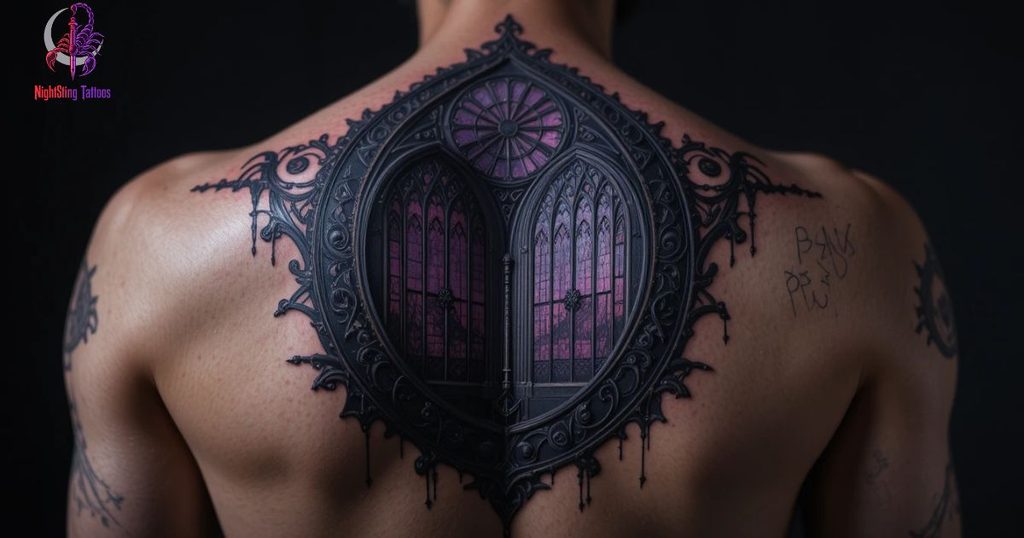
Among the most recognizable sources of inspiration are Gothic cathedrals and Gothic architecture. Pointed arches, ribbed vaults, towers, stone tracery, gargoyles, and narrow windows can be translated into striking tattoo compositions. A cathedral can symbolize faith, endurance, sanctuary, history, or the relationship between darkness and light. The architectural approach works particularly well when the tattoo artist has enough space to preserve structural details.
A cathedral tattoo can be realistic, illustrative, ornamental, or heavily stylized. Gargoyles can create an intimidating focal point, while stained-glass windows introduce geometric color or carefully separated sections of ink. For larger Gothic Tattoo Designs, architectural lines can provide a strong framework around figures, flowers, crosses, or text. On a back or sleeve, repeated arches can also create a natural sense of movement.
The historical atmosphere of medieval tattoo designs does not require an exact reconstruction of a particular building. An artist can borrow pointed arches, stone textures, towers, and window shapes to create an original composition. This makes Gothic architecture a flexible source rather than a strict visual formula.
Gothic Calligraphy and Lettering
Words can become the central visual element of Gothic Tattoo Designs when the typography is chosen carefully. Gothic calligraphy and blackletter fonts create an unmistakable historical mood through sharp strokes, dramatic capitals, dense forms, and ornamental flourishes. A short phrase, surname, date, or personal motto can therefore become both readable text and decorative artwork.
Gothic lettering works especially well when the wording has personal significance. Latin phrases such as Memento Mori, names, memorial dates, or short statements can fit the theme without requiring a large illustration. However, dense lettering needs enough room between characters. If the design is too small, individual strokes may visually merge as the tattoo settles.
For Gothic lettering tattoos, the artist should consider readability from normal viewing distance. A beautiful reference image is not automatically suitable for skin. Blackletter tattoo work needs deliberate spacing, appropriate line weight, and a size that allows the letters to breathe. These details become even more important when the design contains long words or multiple lines.
Read Also: 40 Meaningful Name Neck Tattoo Ideas To Inspire Your Ink
Design Adaptability: Brutality vs. Elegance
One of the greatest strengths of Gothic Tattoo Designs is their ability to move between aggressive and elegant aesthetics. A composition can use heavy black shapes, skeletal imagery, and sharp geometry, or it can emphasize lace, roses, fine filigree, and graceful curves. Both approaches belong naturally within the same visual family because Gothic culture has always contained both dramatic darkness and refined ornament.
The dark aesthetic also works across different tattoo techniques. Some people prefer dense blackwork, while others choose soft gradients, realistic shading, fine lines, or controlled negative space. Dark tattoo designs can therefore be customized rather than copied. The goal is to identify which elements create the desired mood and then arrange them around the anatomy and personality of the wearer.
Male Aesthetics
Gothic Tattoo Designs for men often emphasize scale, contrast, strength, and architectural structure. Broad areas such as the chest, shoulder, upper arm, and back can support skulls, warriors, gargoyles, crosses, demons, and large ornamental compositions. Heavy blackwork tattoo designs can make these pieces especially dramatic, while realistic tattoo shading can give stone, metal, bones, and fabric greater dimensionality.
Popular masculine Gothic tattoos can include a Grim Reaper tattoo, skulls, ravens, medieval armor, dark angels, or biomechanical elements. Biomechanical designs can be combined with Gothic arches or skeletal anatomy to create a futuristic interpretation of medieval darkness. The result can feel powerful without depending entirely on horror imagery.
For people searching for Gothic tattoo designs for guys, proportion matters. A large shoulder can support a complex composition, whereas a small forearm may work better with one dominant symbol. Strong Gothic Tattoo Designs usually have a clear focal point rather than placing every possible Gothic symbol into one area.
Feminine Nuances
Gothic aesthetics can be soft, romantic, elegant, and highly ornamental. Gothic tattoo designs for women often combine roses, lace, filigree, cameos, moons, butterflies, crosses, eyes, and delicate architectural details. The darkness remains present, but the visual language can become more refined and jewelry-like.
Dark feminine tattoos can emphasize graceful curves and carefully controlled contrast. Gothic roses are particularly versatile because a rose can symbolize love,statues góticos para hombres loss, beauty, secrecy, remembrance, or transformation. Lace tattoos and filigree can frame a central symbol without overwhelming it, making them suitable for the sternum, thigh, ribs, shoulder, or upper back.
For anyone searching for unique Gothic tattoos for females, personalization is more important than following a fixed formula. A Victorian frame around a skull tatuajes goth , a cathedral behind flowers, or blackletter combined with ornamental vines can pr oduce a distinctive result. These Gothic Tattoo Designs allow elegance and darkness to exist in the same composition.
The Aging Factor: The Expansion of Black
Planning for the future is essential when choosing Gothic Tattoo Designs. Dense black areas can look exceptionally powerful when freshly tattooed, but tattoo ink gradually settles and the skin changes with time. Fine details can become less distinct, especially when many lines are placed close together. Good planning therefore considers not only how a tattoo looks immediately after completion but also how it may develop over the years.
The concept of tattoo aging is particularly important for dense blackwork, tiny lettering, intricate lace, and miniature architectural details. A skilled artist can use spacing and contrast to preserve readability. Negative space gives the design visual breathing room and can help separate neighboring elements. The objective is not simply to reduce black ink but to distribute it intelligently.
Tattoo healing also affects the final appearance. During healing, a fresh tattoo can appear darker, more textured, or temporarily less defined before the skin settles. Follow your tattoo artist’s aftercare instructions and avoid judging the permanent result too early. For Gothic Tattoo Designs, patience during healing is especially valuable when the composition contains substantial shading.
A useful principle for Gothic Tattoo Designs is to make small details large enough to survive visual changes. Instead of squeezing ten tiny symbols into a small area, choose two or three major elements and give them room. This approach can preserve the dramatic effect of black ink while reducing unnecessary visual congestion.
Explore More Dark Styles
Exploring related styles can help you refine your own Gothic Tattoo Designs before booking an appointment. You might discover that your ideal aesthetic is closer to Victorian ornament, medieval imagery, traditional blackwork, realistic horror, or delicate dark romance. Looking beyond a single category often produces a more original tattoo.
Consider Gothic tattoo inspiration based on themes rather than isolated pictures. Search for architecture if you love historical structures, botanical references if you prefer romantic imagery, or typography if words matter most. Mysterious tattoo designs become more meaningful when every major element has a reason to exist.
You can also combine Gothic tattoo meanings with your own experiences. A skull may represent mortality, a rose may represent love or loss, tatuajes goticos and a cross may express faith or heritage. Gothic tattoo symbolism does not have to be universal. Personal interpretation can be more important than an established definition.
Gothic tattoo designs male
Gothic tattoo designs male can range from monumental architecture to aggressive skull compositions and dark symbolic portraits. Large-scale pieces are particularly effective on the back because the broad surface allows the artist to create depth through foreground, middle ground, and background elements. A central Grim Reaper can be surrounded by arches, smoke, ravens, roses, chains, or fragments of stone.
For the chest, symmetrical designs can follow the natural structure of the pectorals. A cross, skull, cathedral window, or ornamental emblem can become the central focus while smaller details extend toward the shoulders. Gothic chest tattoo compositions benefit from careful alignment because the anatomy naturally creates a central axis.
The forearm offers a narrower canvas, so vertical imagery often works best. A tower, reaper, dagger, cross, skeletal figure, or elongated ornamental motif can follow the arm naturally. Gothic forearm tattoo concepts should retain enough contrast to remain readable at a smaller scale.
Gothic tattoo designs with meaning
Meaningful Gothic Tattoo Designs often revolve around mortality, memory, spirituality, transformation, rebellion, beauty, or the passage of time. Memento Mori is one of the most recognizable concepts because it reminds the viewer of mortality and the temporary nature of life. It can be represented through a skull, hourglass, dying flower, candle, clock, or grave imagery.
Skull tattoos are not limited to one interpretation. They can symbolize mortality, change, remembrance, resilience, or acceptance of life’s impermanence. A skull combined with flowers can create a contrast between decay and growth. A skull surrounded by architecture can make the piece feel historical, while a skull with lettering can make the message more personal.
A Gothic cross tattoo can also carry different meanings depending on the wearer. It may express Christian faith, remembrance, protection, spiritual identity, or an interest in medieval visual culture. Adding roses, chains, rays, stone textures, or ornamental framing changes the emotional character of the design.
Some people choose religious symbolism because it connects the tattoo to their personal beliefs. Others use religious imagery as part of a historical or artistic composition. The meaning should be discussed honestly with the artist when symbols carry cultural or spiritual significance.
Gothic Tattoos For females
Gothic Tattoos For females can explore romantic darkness without relying on excessive visual heaviness. Fine floral elements, ornamental frames, moons, ravens, butterflies, crosses, eyes, and Victorian motifs can create a sophisticated composition. The strongest designs are often those where the darkness comes from mood, symbolism, and contrast rather than simply from large areas of solid ink.
A Gothic sternum tattoo can use symmetrical ornamentation that follows the center of the body. Filigree, roses, lace, a cross, or a central gemstone-like motif can create a jewelry-inspired effect. Because the sternum has a distinctive shape, the artist should adapt the design rather than placing a rectangular image onto it.
A Gothic thigh tattoo offers more room for elaborate storytelling. A woman may combine a Victorian portrait with roses, a cathedral, a raven, ornamental borders, and delicate lettering. This larger placement gives intricate Gothic tattoos enough space to maintain separation between fine details.
Gothic tattoo designs for guys
Gothic tattoo designs for guys often use heavier contrast and larger visual structures, but there is no rule requiring every male design to be aggressive. A man can choose Victorian roses, ornate lettering, cathedral architecture, or a subtle cross while keeping the composition masculine through scale and placement.
A full arm composition can connect several elements into a single narrative. For example, a cathedral at the upper arm can transition into a skull and rose arrangement before reaching a blackletter phrase near the forearm. This creates a cohesive Gothic sleeve tattoo instead of several unrelated images placed beside each other.
Back pieces can be even more ambitious. A central figure can occupy the spine while wings, arches, roses, clouds, or ornamental patterns extend toward the shoulders. A Gothic back tattoo is particularly suitable for people who want a dramatic piece with multiple layers and strong symmetry.
Victorian gothic tattoo designs
Victorian gothic tattoo designs focus on elegance, ornament, romance, mourning, and historical atmosphere. Cameos, lace, roses, ornate frames, antique keys, candles, clocks, gloves, mirrors, and handwritten phrases can all contribute to this aesthetic. Unlike purely horror-oriented work, Victorian Gothic often makes darkness feel luxurious.
Victorian Gothic references can also draw from the visual language of nineteenth-century decorative art. Fine borders and intricate ornamental forms can frame a central portrait or symbol. A realistic black and gray approach can make the tattoo resemble an aged illustration, while selective color can emphasize a rose, gemstone, or stained-glass detail.
For those interested in Victorian tattoo designs, restraint can be more effective than excessive decoration. Choose one central theme and support it with a limited number of secondary motifs. This gives the tattoo a visual hierarchy and makes its macabre beauty easier to appreciate.
Unique gothic tattoos For females
Unique gothic tattoos for females can move beyond familiar skulls and crosses by exploring less predictable combinations. A woman might combine a moth with cathedral windows, a portrait with thorny roses, or a delicate hand holding an antique candle. Macabre tattoo ideas become more distinctive when the composition has a narrative rather than simply displaying popular symbols.
Another option is to reinterpret familiar motifs through scale. A tiny gargoyle can become an ornamental accent, while a large Gothic rose can serve as the dominant focal point. Symbolic Gothic tattoos can also use personal dates, initials, objects, or phrases that have meaning to the wearer.
For a sophisticated result, combine fine details with controlled negative space. The skin between ornamental lines can function almost like the background of an engraving. This technique helps maintain clarity while preserving the dark aesthetic that defines the genre.
How to Choose Gothic Tattoo Placement
Choosing Gothic tattoo placement should happen at the same time as choosing the artwork. A detailed architecture piece needs more room than a simple cross, while lettering needs sufficient width and height to remain readable. Think about how the design will look when the body is relaxed and when the surrounding muscles or joints move.
The forearm, chest, back, thigh, shoulder, ribs, and sternum each create different opportunities. A Gothic sleeve tattoo can flow around the arm, while a Gothic back tattoo can support monumental scenes. A Gothic chest tattoo can use symmetry, and a Gothic sternum tattoo can emphasize ornamental balance.
Visibility should also influence the decision. If you work in an environment where tattoos need to remain covered, the torso or upper thigh may offer more flexibility. If visibility is part of the appeal, the forearm or upper arm may be preferable. Good Gothic Tattoo Designs should feel natural on the chosen body area rather than appearing pasted onto it.
Gothic cross tattoo designs
Gothic cross tattoo designs can range from simple black silhouettes to highly elaborate architectural compositions. A plain cross can feel solemn and powerful, while an ornate version may incorporate pointed arches, vines, roses, chains, stone textures, or lettering. The right level of decoration depends on whether the cross is meant to be the focal point or part of a larger scene.
A cross can also be combined with Gothic calligraphy, skulls, roses, or a cathedral. When the composition contains many elements, the artist should establish a clear hierarchy. One symbol should dominate while supporting motifs create depth.
Skull Gothic tattoos
Skull Gothic tattoos remain popular because the skull instantly communicates mortality and transformation. They can be realistic, engraved, ornamental, skeletal, or surrounded by architectural elements. A realistic skull may emphasize anatomy, while an ornamental skull can feel more connected to Victorian design.
The most compelling skull compositions often introduce contrast. Flowers soften the bones, candles suggest remembrance, and Gothic architecture adds historical atmosphere. Macabre beauty emerges when the tattoo makes something associated with death visually elegant rather than merely frightening.
Blackwork and black and gray approaches
Blackwork is a natural fit for Gothic aesthetics because solid black areas can create powerful silhouettes and deep contrast. It is particularly effective for crosses, architecture, lettering, ravens, skulls, and large ornamental shapes. However, heavy saturation should be planned carefully so the composition does not lose its internal details.
Black and gray tattoos provide another route. Gray washes can create stone textures, clouds, skin, smoke, fabric, and realistic shadows without filling every area with solid black. This approach is especially useful for portraits and architectural scenes where depth matters.
Black ink is also versatile because it can create both crisp outlines and dramatic shadows. The artist can combine dense saturation with lighter sections to build a visual hierarchy. In many Gothic Tattoo Designs, the strongest effect comes from controlling where the black appears rather than maximizing the amount of it.
Gothic Tattoo Meanings and Symbolism

Gothic tattoo meanings vary because symbols have different historical, religious, and personal associations. A raven may suggest mystery, intelligence, remembrance, or death. A rose may represent love, beauty, grief, or secrecy. A cathedral can suggest faith, sanctuary, history, or the search for meaning.
Gothic tattoo symbolism becomes more personal when multiple symbols interact. A rose growing through a skull can suggest beauty surviving mortality. A broken cross can represent struggle or spiritual questioning. A clock surrounded by flowers can express the passage of time. These combinations allow Gothic Tattoo Designs to communicate more than a single isolated image.
Hidden symbolism can also be intentionally subtle. An artist might place initials inside ornamental filigree, incorporate a meaningful date into a blackletter border, or use a particular flower because of its personal association. This approach gives the wearer a private layer of meaning beneath the obvious Gothic appearance.
Tattoo Shading, Detail, and Contrast

Good tattoo shading can transform a flat Gothic illustration into a scene with convincing depth. Soft gradients can create clouds and smoke, while stronger shadows can define stone arches, bones, clothing, and facial features. The technique should match the subject rather than applying the same shading pattern everywhere.
A tattoo containing architecture benefits from controlled perspective. A cathedral should have enough tonal variation to separate its foreground from distant structures. Portraits need careful transitions around the face. Roses need shadows between petals. Lettering requires enough contrast to remain legible.
The best Gothic Tattoo Designs therefore depend on more than subject selection. Line quality, saturation, spacing, scale, and contrast all contribute to the final result.
Gothic art, horror literature, and Victorian influence
The visual language of Gothic tattoos has connections with Gothic art, literature, architecture, and decorative traditions. Horror literature contributed many themes associated with the modern Gothic imagination, including haunted settings, mysterious figures, death, isolation, romantic tragedy, and supernatural imagery.
Victorian art adds another layer through ornament, mourning culture, portraiture, elaborate clothing, botanical motifs, and decorative framing. A tattoo inspired by this era can feel elegant even when the subject is dark. Combining Victorian Gothic details with modern tattoo techniques creates an aesthetic that feels historical without becoming a literal reproduction.
The influence of medieval architecture is equally important. Pointed arches, towers, stone tracery, and gargoyles can establish the atmosphere instantly. When these forms are combined with Gothic lettering or religious imagery, the tattoo can resemble an illustrated fragment from an imagined medieval manuscript.
Medieval demons and darker imagery

Medieval demons can create some of the most dramatic Gothic Tattoo Designs. Rather than using generic monsters, consider giving the figure a historical visual language through horns, wings, armor, medieval clothing, architectural backgrounds, or manuscript-inspired ornament.
A demon can symbolize fear, inner conflict, temptation, resilience, or personal transformation. The meaning does not have to be literal. Some people simply appreciate the unsettling visual character of the subject.
The same principle applies to a Grim Reaper tattoo. The figure may represent death, acceptance, change, remembrance, or the passage of time. Combining the Reaper with a clock, flowers, cathedral arches, or a quote can make the design more personal.
Biomechanical Gothic combinations
Biomechanical designs can introduce an unexpected modern element into traditional Gothic imagery. Mechanical ribs can replace architectural columns, diseños tatuajes goticos gears can appear behind a skull, or metal structures can merge with bones and cathedral forms. This creates a hybrid aesthetic that connects medieval darkness with futuristic body art.
The combination works particularly well in large pieces because biomechanical textures require room to show depth. A shoulder, back, chest, or thigh can provide enough space for the artist to transition between organic anatomy, machinery, and Gothic ornament.
Gothic roses, lace, and filigree
Gothic roses are among the easiest motifs to personalize. A rose can be realistic, blacked out, thorn-covered, surrounded by lace, or incorporated into a cathedral composition. Its emotional meaning can change through color, condition, surrounding objects, tatuajes góticos hombre and placement.
Lace tattoos add delicacy and can soften otherwise intense imagery. They work especially well around portraits, crosses, hearts, roses, and sternum compositions. Filigree performs a similar function by creating ornamental movement around the main subject.
When these elements are combined with negative spacediseños tatuajes goticos , the tattoo can achieve a sophisticated balance. The dark sections establish the Gothic atmosphere, while open skin prevents the design from becoming visually crowded.
Gothic tattoos for different personalities

Not everyone who likes Gothic aesthetics wants a frightening tattoo. Someone drawn to history may prefer cathedrals and medieval ornaments. A romantic personality might choose roses and Victorian frames. A person interested in mortality may choose a Memento Mori composition. Someone attracted to typography may focus almost entirely on blackletter.
This is why Gothic tattoo inspiration should begin with emotion rather than a trend. Ask what you want the design to communicate. Do you want mystery, strength, remembrance, romance, spirituality, rebellion, or simply visual beauty? Once that decision is clear, selecting imagery becomes much easier.
How to Make Gothic Tattoo Designs More Original
Originality does not require inventing an entirely new symbol. It often comes from combining familiar elements in a way that reflects your own story. Instead of choosing a standard skull, consider what surrounds it and why. Instead of using a generic cross, incorporate architecture or lettering connected to your personal interests.
You can also customize proportions. A giant rose surrounding a small skull creates a different mood from a large skull surrounded by tiny roses. Changing the scale of familiar motifs can make Gothic Tattoo Designs feel fresh without making them visually confusing.
Another option is to introduce one unexpected element. A Gothic cathedral with botanical roots, a Victorian portrait with biomechanical details, or a blackletter phrase surrounded by delicate moths can create a distinctive identity while remaining recognizably Gothic.
Tattoo Healing and Long Term Care

Fresh tattoos require proper aftercare, and detailed Gothic Tattoo Designs deserve particular attention because dense areas can take time to settle. Follow the specific instructions provided by your tattoo artist because aftercare recommendations can differ depending on the technique, placement, and covering method.
Avoid picking or scratching healing skin, and allow the tattoo to settle naturally. Once healed, protecting tattooed skin from excessive sun exposure can help preserve the appearance of the artwork. Long term maintenance matters because tattoo aging is a natural process rather than a sign that the original design was unsuccessful.
Dense black ink may remain visually strong for many years, but fine lines and tiny gaps can change as the tattoo ages. Planning for this reality from the beginning is one of the best ways to protect the long term appearance of your design.
Frequently Asked Questions
What is a gothic style tattoo?
A Gothic style tattoo uses imagery and visual techniques associated with darkness, or realistic horror imagery. The style is broad, so a Gothic tattoo can be frightening,spiritual, or symbolic.
What are 10 common tattoo styles?
Ten widely recognized tattoo styles include traditional, neo traditional, realism, blackwork, fine line, geometric, Japanese, watercolor, illustrative, and Gothic.
How to choose a gothic tattoo design?
Start with the emotion or meaning you want the tattoo to communicate. Then choose a central subject such as a cathedral, skull, rose, cross, portrait, creature, or phrase.
What are examples of gothic art?
Examples include medieval cathedral architecture, pointed arches, stained glass, gargoyles, religious imagery,Victorian mourning art, dark romantic illustration, ornate metalwork, and macabre visual themes.
Who is the famous Gothic artist?
There is no single artist who represents all Gothic art because the tradition spans architecture,modern subcultures.develop their own interpretations of Gothic realism, blackwork, ornamental work,and dark illustrative art.
Conclusion
The appeal of Gothic Tattoo Designs lies in their ability to make darkness beautiful. Cathedrals can represent history and faith, skulls can express mortality and transformation, roses can introduce romance, and black letters can turn a meaningful phrase into a visual statement. From powerful masculine compositions to delicate Victorian ornament, the style offers enough flexibility for almost any personality.
Before choosing your final piece, think about meaning, scale, placement, contrast, and tattoo aging. Give detailed artwork enough space, use negative space strategically, and choose an artist whose portfolio matches your desired technique. Whether you want a monumental back scene, an elegant sternum design, a dramatic sleeve, or a small symbolic piece, the right Gothic Tattoo Designs can transform historical darkness into deeply personal body art.